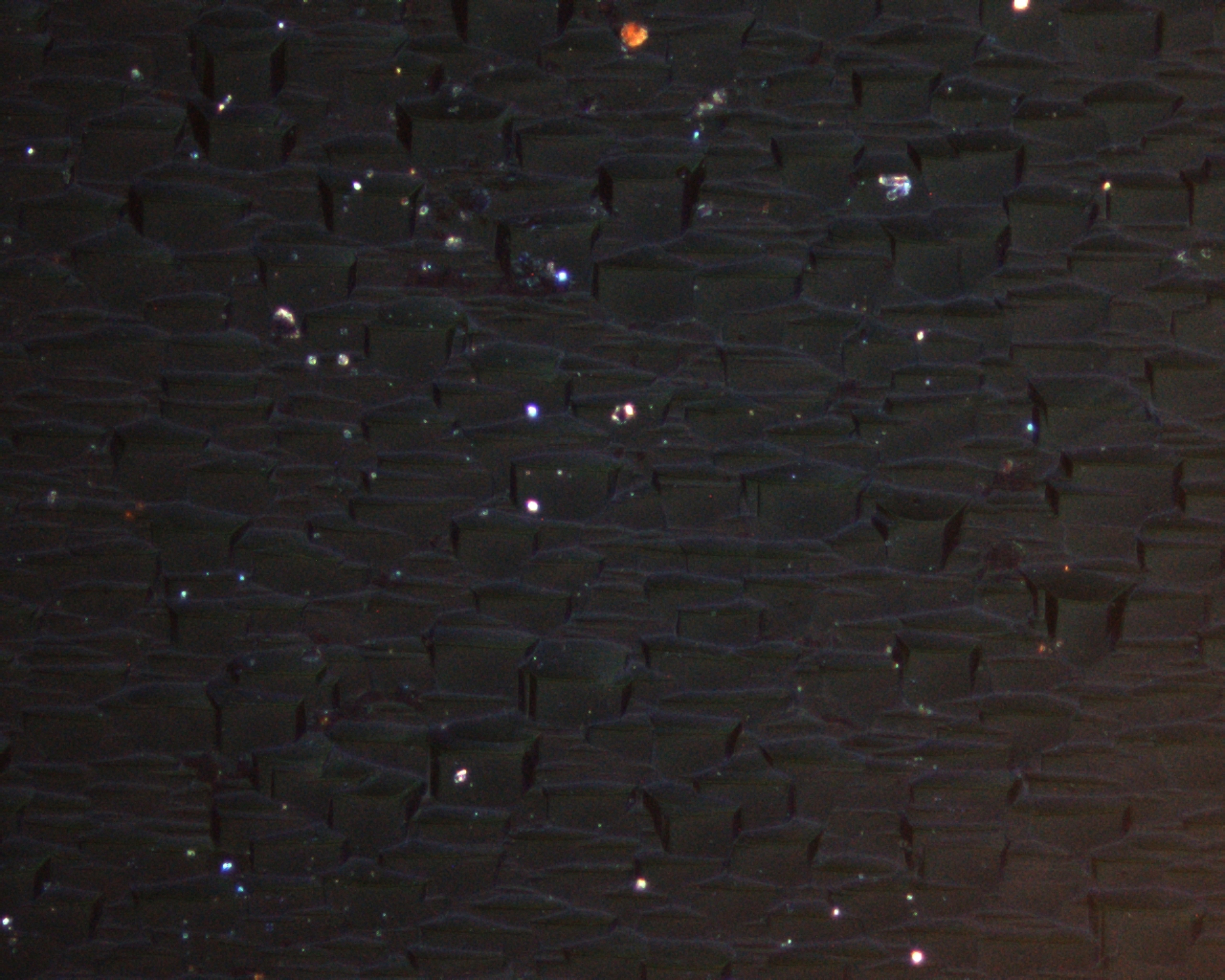
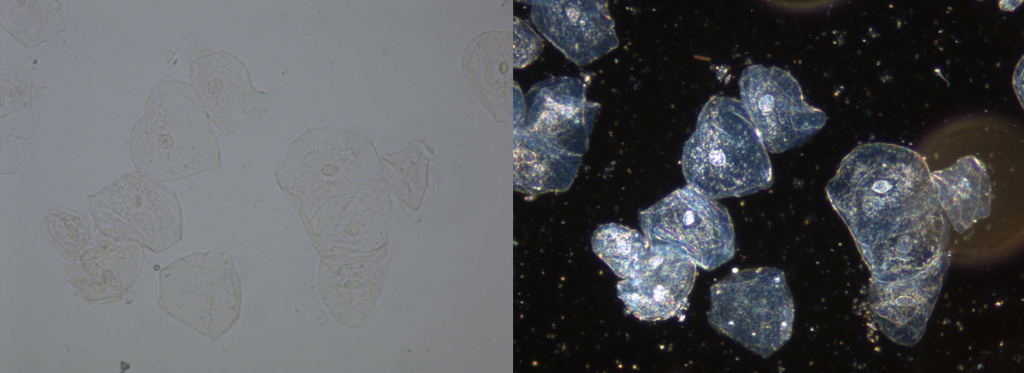
19세기 중순 경 개발되어짐. 초기에는 암석과 광물의 연구에 주로 사용되어졌으나, 점차로 그 용도가 넓어져서 의약품, 공업제품 등 산업 전반에 걸쳐 이용분야가 확대되었음.
편광현미경의 사용 목적
샘플의 광학적 성질의 조사하여 구성하는 물질이 무엇으로 이루어졌는지 동정(同定) 하기 위해 사용 됨.
광학적 성질에 의한 샘플의 분류
광학적등방체 ( (Isotropic material )
: 샘플에 빛이 통과 할때 어떠한 방향으로 빛이 진행하더라도 모든 방향에 대하여 동일한 광학적 영향을 준다.(복굴절 하지 않는다.)
예: 유리 등
광학적이방체 ( Anisotropic material )
: 샘플에 빛이 통과 할때 빛이 진행하는 방향(각도)에 따라 다양한 복굴절을 한다.
– 일축성(isotropic body) 결정_이방체
: 빛이 진행 할 때 복굴절하지 않는 광축을 하나만 가지고 있다. 예: 방해석, 석영 등
– 이축성(Anisotropic body) 결정_이방체 : 빛이 진행 할 때 복굴절하지 않는 광축을 두개 가지고 있다. 예: 운모, 장석, 각섬석, 휘석, 감람석 등
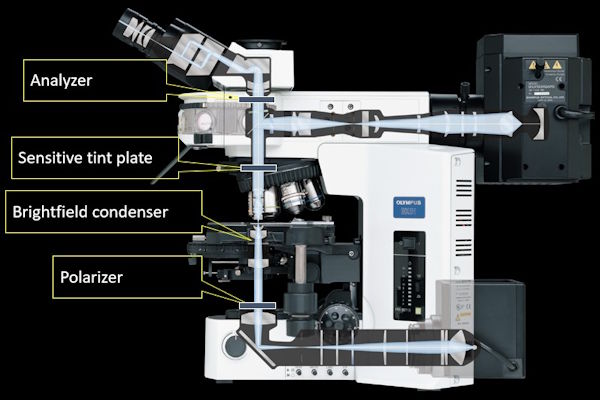
전용 편광 현미경의 구성품 (일부)
Compensator에 대한 구성 및 설명은 포함되어 있지 않습니다.
투과형 편광 & 반사형 형광 현미경 (전용편광현미경의 사진이 아닙니다.) 이 장비는 투과형 편광현미경에 Tint plate가 추가된 현미경 입니다. 전용 편광현미경은 스테이지와 검광자의 회전각을 각각 읽을 수 있어야 합니다.
The First Order (Full wave) Retardation Plate
제조사
분류
일반명칭
모델명
OLYMPUS JAPAN
편광전용현미경
λ필터
U-TP530
Optical path differences ranging from a fraction of a wavelength up to several wavelengths can be readily estimated using a first order (or full wave) retardation plate. This versatile tool is known by several names, including a red plate, red-I (red-one) plate, lambda (λ) plate, gypsum plate, selenite plate, sensitive violet, or simply a color tint plate, and adds a fixed optical path difference between 530 and 560 nanometers (depending upon the manufacturer) to every wavefront in the field. The first order retardation plate is a standard accessory that is frequently utilized to determine the optical sign (positive or negative) of a birefringent specimen in polarized light microscopy. In addition, the retardation plate is also useful for enhancing contrast in weakly birefringent specimens.
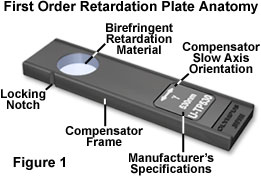
The elegantly simple anatomy of a first order retardation plate is presented in Figure 1 for a typical commercial unit. Retardation materials employed in construction of the plate vary according to the application, but usually consist of either an optical mineral thin section (such as gypsum/selenite, quartz, calcite, or mica) or a highly aligned birefringent linear organic polymer sandwiched between two isotropic optically flat glass plates. Regardless of the material used in producing retardation, the optical path difference (usually inscribed on the retardation plate frame) and optical axis orientation of the birefringent retarding material must be carefully controlled so that the plate can add a known retardation value to both the high and low refractive index azimuths. As illustrated in Figure 1, the birefringent retardation material is positioned in a rectangular frame that is inserted into the microscope optical pathway at a 45-degree angle with respect to the transmission orientations of the polarizer and analyzer. The direction of the slow (high refractive index) axis of the wavefront ellipsoid is indicated on the retardation plate frame as a double-headed arrow accompanied by the Greek symbol for “gamma” (γ). In most cases, the slow axis orientation is perpendicular to the long dimension of the retardation plate frame, although this fact should be verified before attempting to use the instrument. Modern first order retardation plates are built in a frame having standardized DIN dimensions (6 × 20 millimeters) that will enable their use in a variety of microscopes.
The first order retardation plate is designed to introduce a relative retardation of exactly one wavelength (in the green or 550 nanometer region) between the ordinary and extraordinary wavefronts passing through the plate when the birefringent retardation material is illuminated by linearly polarized light at a 45-degree incident angle to the index ellipsoid.
As a result, green wavelengths emerge from the retardation plate crystal still linearly polarized and having the same orientation as when they entered the retardation material (parallel to the polarizer). These wavelengths are perpendicular to the analyzer, thus are absorbed and do not pass through.
The orthogonal wavefronts of all other wavelengths will experience some degree of retardation (less than a full wavelength) and will emerge from the retardation plate having varying degrees of elliptical polarization. These wavefronts are therefore able to pass a component vector through the analyzer. Subtracting the green wavelengths (blocked by the analyzer) from white light yields bright magenta-red, which results from a combination of all visible light spectral colors when the green wavelength band is missing. The magenta color observed in the microscope when a first order retardation plate is inserted into the optical train is a direct result of the events described above and is the origin for much of the common nomenclature describing this important qualitative tool.
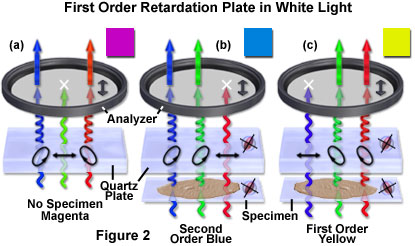
The behavior of a quartz first order retardation plate in polarized white light, symbolized by a combination of red, green, and blue wavefronts, is reviewed in Figure 2. Without a specimen in the optical pathway (Figure 2(a)), the retardation plate induces an elliptical polarization vector to the red and blue waves as they pass through, but the green light travels through the quartz crystal as a linearly polarized wavefront that is absorbed by the analyzer. As a result, only a component of the red and blue waves is able to pass through the analyzer to produce a spectrum of white light minus the green wavelengths, which is seen in the microscope as a bright magenta background.
When a birefringent specimen with a wavefront ellipsoid parallel to the retardation plate is inserted into the optical pathway (Figure 2(b)), the relative retardation of orthogonal wavefronts is increased across the viewfield so that the color (red) now exhibiting linear polarized behavior is shifted to longer wavelengths. The blue and green wavelengths are elliptically polarized and interfere at the intermediate image plane to form a hue similar to second order blue (an addition color). Rotating the specimen by 90 degrees alters the relationship between the wavefront ellipsoids (Figure 2(c)) so that they are now perpendicular. In this case, the relative retardation of the orthogonal wavefronts is decreased across the viewfield and the shorter (blue) wavelengths emerge as linearly polarized light (only to be absorbed by the analyzer). Elliptically polarized green and red wavelengths ultimately recombine to form a first order yellow (subtraction) interference color.
Inserting a first order retardation plate into the optical path of a polarized light microscope introduces a dramatic display of interference colors in thin, birefringent specimens that is not only aesthetically beautiful, but also highly useful as an indicator of several optical properties. Quantitative evaluations of relative retardation and determinations of the index ellipsoid orientation are readily achieved with a first order retardation plate. In geological and materials investigations, first order retardation plates are often employed to determine specimen thickness and to identify birefringent crystalline and polymeric materials. The tool is capable of measuring retardations with an accuracy of approximately 2 nanometers in specimens that have relatively low (one-third of a wavelength) optical path differences.
With simple uniaxial birefringent materials, the first order retardation plate can be employed to determine whether the extraordinary wavefront is slower or faster than the ordinary wavefront and thus determine the sign of birefringence. If the extraordinary wavefront is slower than the ordinary wavefront, the specimen displays positive birefringence. Conversely, a negative sign of birefringence is observed in specimens that have an ordinary wavefront that is slower than the extraordinary wavefront. First order retardation plates are ideal for use with specimens that have very low order (or only gray-level) interference colors when observed in the polarized light microscope. Before attempting an analysis of birefringence, specimens must first be oriented with the index ellipse in a diagonal position (45-degree angle) with respect to the microscope polarizer and analyzer. The two vibration (ordinary and extraordinary) azimuths will then run Northeast-Southwest and Northwest-Southeast, whereas the polarizer is oriented East-West and the analyzer North-South (as seen in the microscope viewfield).
After the specimen has been properly oriented, the colors appearing in the microscope eyepieces represent interference that is generated by the additive effects of the specimen and the first order retardation plate. If the specimen slow vibration axis is superimposed over the corresponding axis of the retardation plate, the additive retardation effects will result in higher order interference colors (termed theadditive position). However, if the fast axis of the specimen is parallel to the slow axis of the retardation plate, the relative retardation will be decreased and result in lower order interference colors (thesubtractive position). As an example, in a relatively thin, elongated birefringent crystal that displays only first order gray intensities under crossed polarized illumination, addition of a first order retardation plate to the optical train will result in quadrants that display blue and yellow interference colors, depending upon the orientation of the crystal. In positive crystals, yellow interference colors are observed when the crystal is oriented Southeast to Northwest, while blue colors result from rotating the crystal by 90 degrees (into a Northeast-Southwest direction). Likewise, negative crystals exhibit yellow colors when oriented Northeast-Southwest and blue colors when oriented Southeast-Northwest.
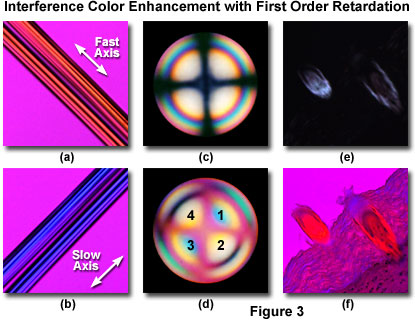
This effect is illustrated with a pair of synthetic acetate fibers in Figures 3(a) and 3(b). Without a first order retardation plate in the optical path, the fibers appear birefringent with a 140-nanometer first order gray intensity superimposed on a jet black background (not illustrated). When the long axis of the synthetic acetate is oriented Northwest-Southeast and a first order retardation plate inserted into the microscope tube, the fibers acquire a first order yellow hue on a magenta background (Figure 3(a)). Rotating the microscope stage by 90 degrees (Northeast-Southwest) alters the interference color to second order blue (Figure 3(b)). From these results, the optical sign of birefringence for the acetate fibers is judged to be positive.
The sign of birefringence can also be readily determined using a first order retardation plate coupled to observation of conoscopic interference patterns with a Bertrand lens (see Figures 3(c) and 3(d)). When a Bertrand lens is inserted into the optical train of a polarized light microscope (between the objective rear aperture and the observation tubes), the conoscopic image of a uniaxial quartz crystal appears as a series of concentric rings having increasing orders of interference fringes from the center to the periphery, which are superimposed on a darkened Maltese cross (Figure 3(c)). Inserting a first order retardation plate into the microscope nosepiece or intermediate tube divides the image into quadrants that display higher order interference colors (Figure 3(d)). If the first and third quadrants (see Figure 3(d)) of the conoscopic image produce additive interference colors (blue and higher), the crystal is positively birefringent. However, if the second and fourth quadrants add to higher interference colors, the crystal is negatively birefringent. The conoscopic image of quartz (Figure 3(d)) reveals that the optical sign of birefringence is positive in quartz having this crystalline lattice structure. Biaxial crystals can also be examined conoscopically to determine their sign of birefringence.
First order retardation plates are also efficient at increasing contrast in very weakly birefringent specimens that are difficult or impossible to detect using crossed polarized illumination alone. Many of the common birefringent biological assemblies examined in polarized light, such as cell walls, starch granules, lignin, microtubules, and actin filaments, fall into this category. An excellent example is provided by a thin section of human tongue, which displays several birefringent structures (Figures 3(e) and 3(f)) of varying intensity. In crossed polarized illumination (Figure 3(e)), weakly birefringent condensed formations at the edge of the tissue are difficult to image and striated muscle tissue supporting the structures is absent. In contrast, when a first order retardation plate is added to the optical train, the structure of all birefringent features becomes readily apparent (Figure 3(f)) and the higher order (blue and yellow) interference colors provide an indication of the optical sign.
The Quarter Wavelength Retardation Plate
제조사
분류
일반명칭
모델명
OLYMPUS JAPAN
편광전용현미경
1/4λ필터
U-TP137
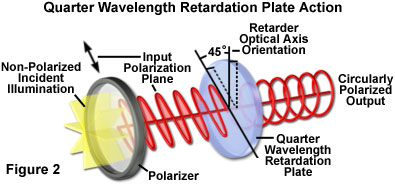
The quarter wavelength retardation plate is a common optical accessory for polarized light microscopy that operates by introducing a relative phase shift of 90 degrees between the orthogonal wavefronts (ordinary and extraordinary) passing through when the plate is illuminated with linearly polarized light. A phase shift of 90 degrees between the ordinary and extraordinary components converts the incident linear polarized light vibrations into either elliptical or circularly polarized light. Quarter wavelength retardation plates are useful for the qualitative analysis of conoscopic and orthoscopic images, and for the assessment of optical path differences in birefringent specimens.
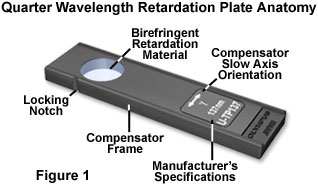
The simple anatomy of a quarter wavelength retardation plate is presented in Figure 1 for a typical commercial unit. Retardation materials employed in construction of the plate vary according to the application, but usually consist of either an optical mineral thin section (such as quartz or mica) or a highly aligned birefringent linear organic polymer sandwiched between two isotropic optically flat glass plates. Regardless of the material used in producing retardation, the optical path difference (usually inscribed on the retardation plate frame) and optical axis orientation of the birefringent retarding material must be carefully controlled so that the plate can add a known retardation value to both the high and low refractive index azimuths of orthogonal wavefronts. As illustrated in Figure 1, the birefringent retardation material is positioned in the window of a rectangular frame that is inserted into the microscope optical pathway at a 45-degree angle with respect to the transmission orientations of the polarizer and analyzer. The direction of the slow (high refractive index) axis of the wavefront ellipsoid is indicated on the retardation plate frame as a double-headed arrow accompanied by the Greek symbol for “gamma” (γ). In most cases, the slow axis orientation is perpendicular to the long dimension of the retardation plate frame, although this fact should be verified before attempting to use the instrument. Modern quarter wavelength retardation plates are built in a frame having standardized DIN dimensions (6 × 20 millimeters) that will enable their use in a variety of microscopes.
The quarter wavelength retardation plate is designed to introduce a relative retardation of exactly one-quarter wavelength (in the green or 550 nanometer region), or 90 degrees, between the ordinary and extraordinary wavefronts passing through the plate when the birefringent retardation material is illuminated by linearly polarized light at a 45-degree incident angle to the index ellipsoid, as illustrated in Figure 2. The resulting phase shift converts the linear input wavefront to a circularly polarized output wavefront. This action occurs because the orthogonal ordinary and extraordinary components have equal amplitudes when linear light oriented at a 45-degree angle to the principal (the fast or slow) axes is incident on a quarter wavelength retardation plate. In a similar manner, the quarter wavelength plate will convert an incoming circularly polarized wavefront into a linearly polarized wavefront.
Commercial quarter wavelength retardation plates are specified by their linear retardation, which is 137 nanometers for the device illustrated in Figure 1 that is designed to operate in light having a principal wavelength of 548 nanometers (in the green region). In polarized light microscopy applications, the quarter wavelength plate is utilized in a similar manner to the full wave retardation plate in order to determine whether the combination of a weakly birefringent specimen and the plate (oriented at a 45-degree angle to the polarizer and analyzer) yield higher or lower order interference colors. However, the quarter wavelength plate has been largely supplanted by the full wave retardation plate due to the superior sensitivity of the latter in producing color changes that can be readily observed. In cases where birefringent specimens display higher order interference colors between crossed polarizers without a retardation plate, then the quarter wavelength plate can often be used to advantage over the full wave plate to determine optical path differences.
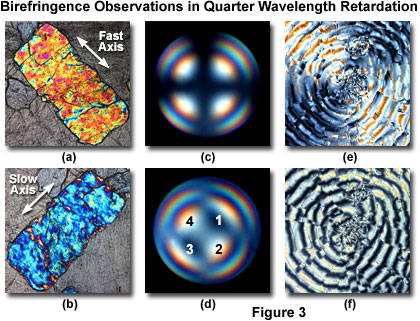
This concept is illustrated in Figures 3(a) and 3(b) for a polished thin section of tactic skarn, which contains inclusions that exhibit first and second order interference colors in polarized light without the presence of a retardation plate or compensator. When a first order retardation plate is employed to determine the optical sign of this birefringent ore, the interference colors are shifted up the Michel-Levy chart by a single wavelength and can lead to confusion during quantitative analysis. Conversely, using a quarter wavelength plate instead produces the customary first order yellow for the fast optical axis (Figure 3(a)) and second order blue hue for the slow axis (Figure 3(b)), allowing for easier identification of the optical properties.
The primary use for quarter wavelength retardation plates is to determine the optical sign of birefringence from interference figures observed in conoscopic mode with a Bertrand lens (Figures 3(c) and 3(d)). Insertion of a quarter wavelength retardation plate resolves the center of a uniaxial interference figure (Figure 3(c)) into two dark spots (Figure 3(d)). If the dark spots are positioned at right angles to the slow vibration axis of the compensator crystal (in quadrants two and four; Figure 3(d)), then the sign of birefringence for the crystal is positive. Conversely, if the dark spots are positioned parallel to the compensator crystal slow axis (in quadrants one and three; Figure 3(d)), the crystal has a negative sign of birefringence. Note that other rings in the interference pattern are translated either towards the center or the periphery of the pattern according to the optical sign. The interference pattern in Figure 3(c) was generated conoscopically using a polished thin section of the mineral lamproite, which exhibits negative birefringence. A similar technique can be employed to determine the optical sign of birefringence for biaxial crystals.
The extinction bands in polarized light images can be eliminated for image analysis purposes by inserting crossed quarter wavelength retardation plates into the microscope optical path with the specimen sandwiched between the two plates. In effect, the retardation introduced by the first quarter wavelength plate is precisely cancelled by the second, so that light reaching the analyzer contains only the retardation introduced by the specimen itself. In practice, one of the retardation plates is inserted into the nosepiece or intermediate tube slot with the slow vibration axis oriented Northeast-Southwest (by convention in modern microscopes). The second plate must be placed between the polarizer and the specimen (usually in or very near the condenser) with the slow axis oriented Northwest-Southeast. The two plates should be fabricated from the same material in order to completely eliminate extinction bands. If the two plates are accurately aligned, a minimum change of polarization colors will be observed in birefringent specimens as they are rotated through 360 degrees with the microscope circular stage. Images of purified riboflavin (Vitamin B2) crystallites in polarized light (Figure 3(e)) alone, and with quarter wavelength retardation plates inserted beneath the stage and above the objective rear aperture are illustrated in Figures 3(e) and 3(f), respectively. Note that the extinction regions of the spherulitic crystallite present in Figure 3(e) have been eliminated by the application of two quarter wavelength plates (Figure 3(f)), which more clearly defines the texture.
In summary, the quarter wavelength retardation plate is capable of detecting optical path differences of (plus or minus) one-half wavelength by rotating the stage through 90 degrees. In this regard, the plate has a sensitivity range lying between the Bräce-Köhler and quartz wedge compensators and overlaps with the de Sénarmont compensator. Unlike many of the adjustable compensators, the quarter wavelength retardation plate can be effectively used in white light, but the most accurate results are obtained when the plate is coupled to the wavelength for which the crystal was prepared (for example, 548 nanometer green light for a 137 nanometer plate). The retardation plate can also be used to produce circularly polarized light by inserting it into the optical path above the polarizer.
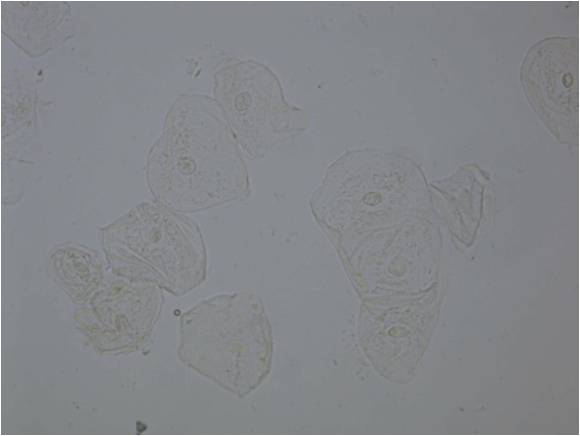
생물현미경에서 사용하는 대부분의 샘플은 무색투명한 특성을 가지고 있기때문에, 배율확대 만을 목적으로 하는 일반 현미경의 관찰법(Bright Field)에서는 투명하고 윤곽이 흐릿하게 보여서 관찰에 어려움이 있습니다.
이 문제를 해결하기 위하여 샘플을 염색하는 방법을 사용하고 있습니다만, 이 방법으로는 염색도주에 살아있는 샘플이 죽어버리기 때문에 살아있는 채로 샘플의 관찰은 할 수 없습니다.
위상차 현미경의 (개요)
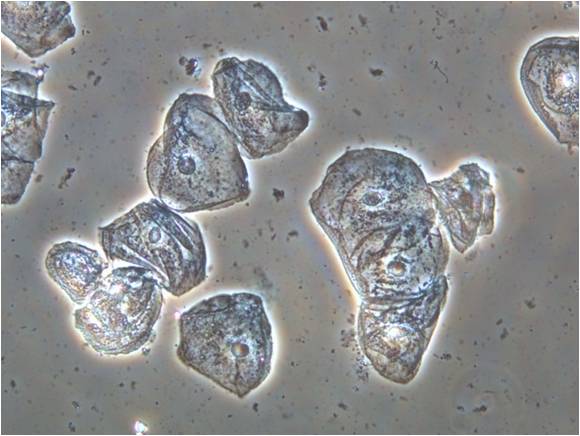
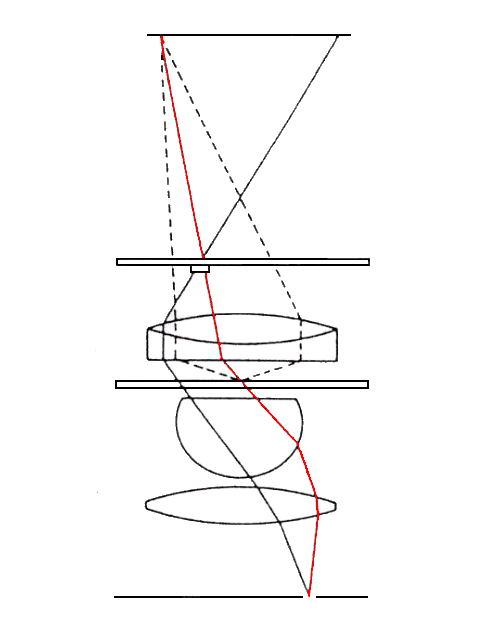
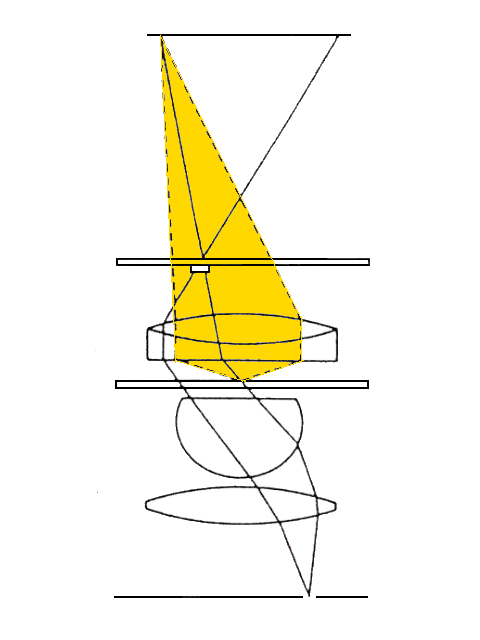
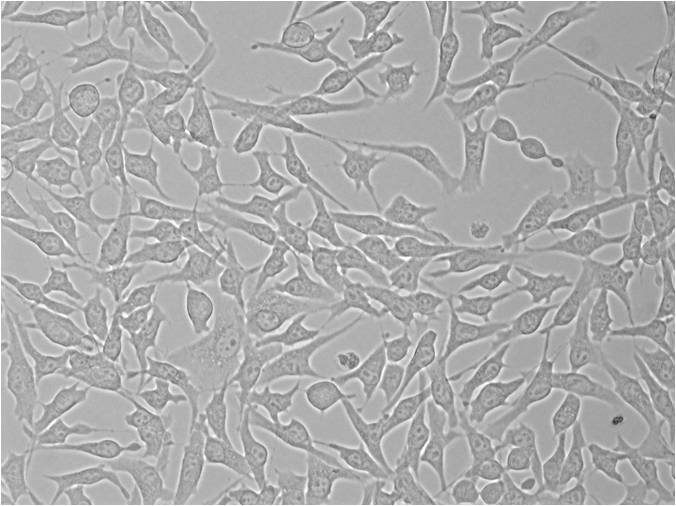
위상차 관찰법(Phase-Contrast)은 샘플을 통과하는 직진광(하단 좌측 이미지)과 이 직진광이 샘플에 통과하면서 발생하는 회절광(하단 우측 이미지) 사이의 위상차 현상을 이용하여 살아있는 세포의 구조와 미생물의 상태변화를 볼게 있게 해주는 관찰법입니다.
위상차 현미경의 원리 설명
샘플의 한 포인트(샘플 평면 중의 한 점)를 통과하는 빛은 두 개의 광학 경로를 가지도록 설계 되어 있으며, 이 두개의 경로를 통과한 빛은 한점에 다시 모여 확대된 상을 만들게 되지만, 다른 경로를 지나왔기 때문에 발생하는 위상차에 의해서 보강 또는 소멸 간섭을 하게 됩니다.
하단의 좌측이미지는 두개의 광학경로 중에 직진광의 경로이며, 하단의 우측이미지는 직진광이 샘플에 닿을때 발생하는 회절광의 경로입니다. 참고로 직진광이 샘플이 없는 포인트를 지나가게 될때는 산란이 생기지않아 회절광은 발생하지 않습니다.
회절광은 직진광의 위상에 비교하여 대략 1/4λ 지연되어 결상하고, 직진광은 위상판에 의하여 1/4λ 또는 3/4λ지연되어 결상하게 됩니다.
직진광이 위상판에 의하여 1/4λ 지연되어 회절광과 동일한 위상을 갖게 되면 직진광과 회절광의 위상이 서로 보강간섭을 하여 진폭이 커지게 되면 배경에서는 직진광의 영향만 받기 때문에 샘플이 배경 보다 밝게 보이게 됩니다. (Negative contrast)
반대로 직진광이 위상판에 의하여 위상이 3/4λ 지연되면 직진광과 회절광은 소멸 간섭을 하게 됩니다만, 다만, 배경(세포가 없는 부분)은 회절광이 발생하지 않기 때문에 직진광에 소멸간섭 현상이 그대로 진행하기 때문에 배경이 더 밝게 보이게 됩니다. (Positive contrast)
물체에 강한 빛을 조사할 때 발현되는 형광을 이용하여 물체의 구조를 관찰하거나 형광의 유무와 색조를 이용하여 물질을 판별한는 현미경입니다.
발현되는 형광의 양을 측광하여 물질의 특성을 파악하고자 하는 경우에도 사용되고 있습니다.
일반 생물 현미경은 주로 투과 조명을 사용합니다만, 근래의 형광현미경은 주로 반사조명을 사용하고 있습니다.
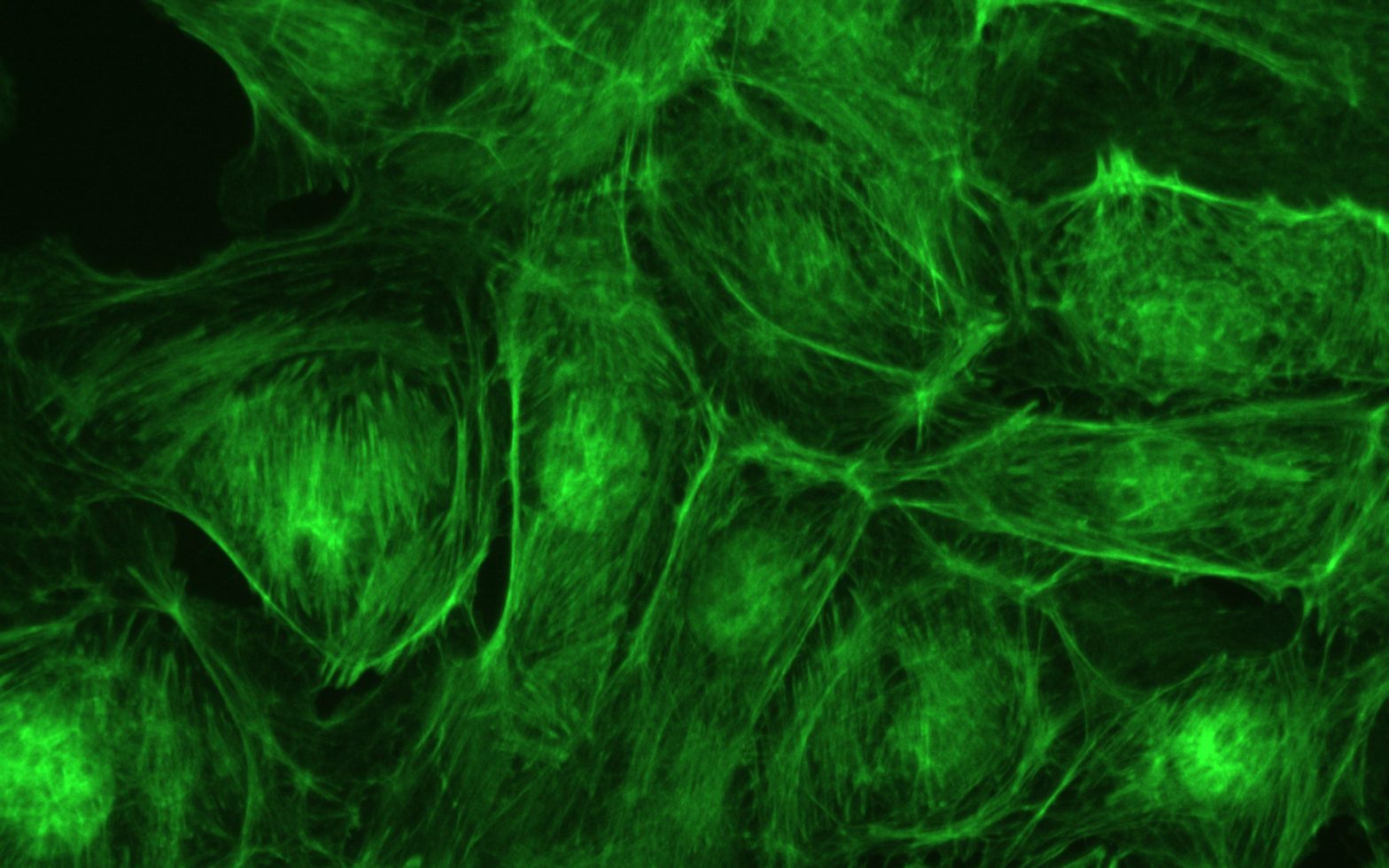
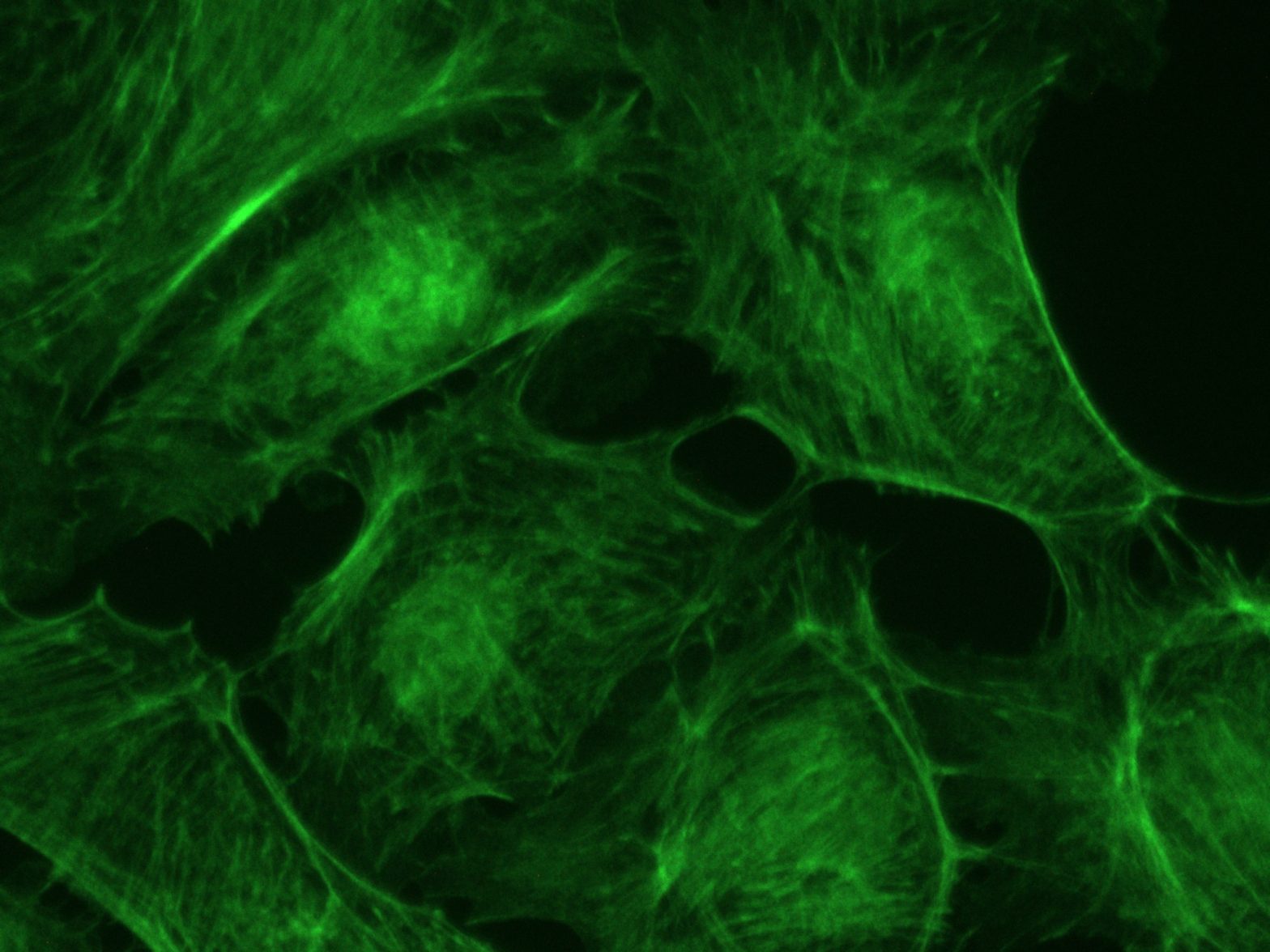
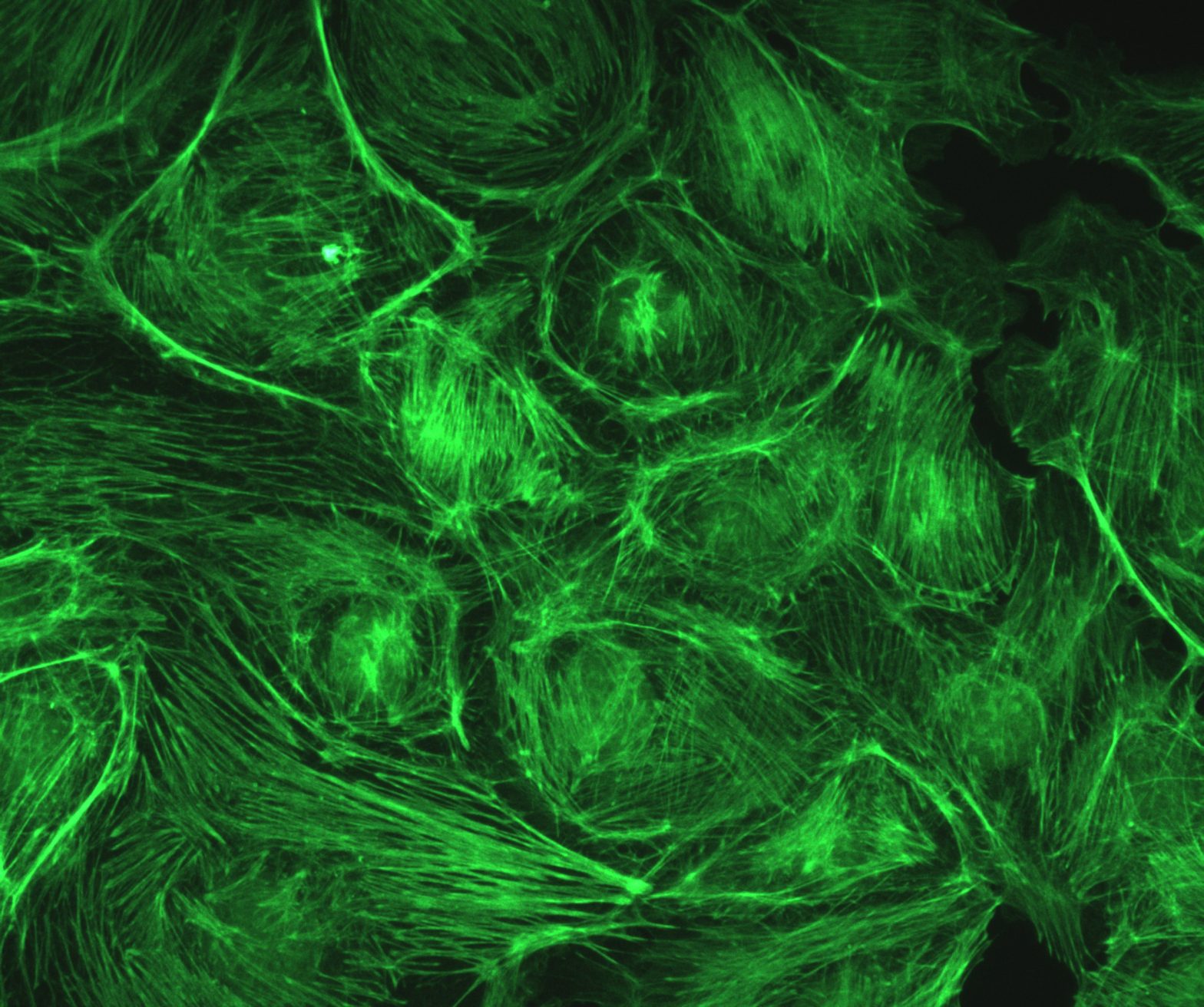
형광 현미경 샘플 이미지 ( by J.H.JIN )
Fluorescence UV excitaionFluorescence Blue excitaionFluorescence Green excitaionFluorescence Merged by JNO-ARM
Fluorochrome ( Fluorophores or Fluorescent Probes)
형광은 특정 파장의 빛을 흡수하는 동시에 다른 파장(흡수 파장보다 긴 파장), 작은 에너지의 빛을 반사하는 분자현상입니다. 이 과정은 excitation(여기) 와 emission(방출, 발광) 으로 알려져 있습니다.
유기 및 비유기의 많은 물질들은 형광 특성을 가지고 있습니다. 형광 현미경을 사용하는 초기의 현미경 학자들은 1차 형광 또는 자가 형광을 주로 보았으나, 지금은 매우 밝은 형광을 가지는 많은 염료(fluorochrome)가 개발되었고 이는 시편의 특정 부분을 염색하는데 사용이 됩니다. 이러한 방법은 2차 혹은 간접 형광이라고 합니다.
이러한 염료는 형광색소(Fluorochrome) 라고 하는데, 항체와 핵산과 같은 다른 유기 합성 물질을 결합할 때는 fluorescent probes 혹은 fluorophores로 불려집니다. (하지만, 일반적으로 이러한 용어들은 종종 같은 의미로 사용되어 지고 있습니다. )
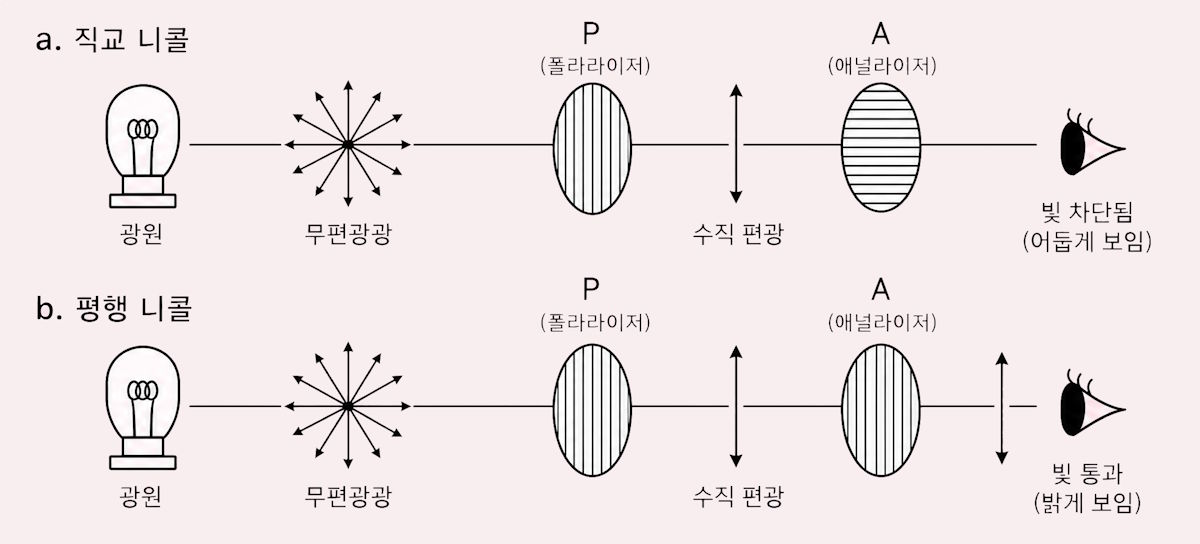
직교니콜에서는 편광판과 검광판의 편광 방향이 수직으로 교차하여 빛이 차단되고, 평행 니콜에서는 두 편광 방향이 평행하여 빛이 통과한다.
상기 이미지와 같이 편광자와 검광자가 90도 각도로 설치 되어 있는 상태를 흔히 직교니콜(Cross Nicol)이라고 불리며, 현미경에서의 주요 사용 목적은 광학적 특성의 변화가 있는 빛만을 통과시키고자 할 때 자주 사용된다.
일반적으로 빛은 모든 방향으로 진동하는 특성을 가지고 있으나, 세로 방향 편광자(좌측필터)를 통한 빛은 세로로 진동하는 빛만이 통과하게 되고, 가로 방향 검광자(우측필터)는 세로로 진동하는 빛을 차단하는 역할을 하기 때문에 실제로 우측으로 투과되는 빛은 없다. (실제로는 Cross Nicol 상태에서도 미약한 광은 투과되지만, 매우 약하기 때문에 없다고 표현하고 있습니다.)
등방체 재질의 샘플의 경우 편광자와 검광자 사이에서 광학적 특성에 변화를 줄 수 없기 때문에 Cross Nicol 관찰에서 어두운 이미지가 얻어진다.
참고로 등방체가 아닌 물질인 플라스틱 등은 편광자를 통과하여 얻은 편광된 빛에 큰 영향을 주기 때문에 이를 염두에 두고 사용하여야 한다.
예를들어 미분간섭 관찰(DIC)은 Cross Nicol 된 상태를 기반으로 설계된 관찰법입니다만, 등방체가 아닌 플라스틱과 같은 재질이 광학 경로상에 있으면 편광에 큰 변화를 주어 DIC 광학 설계를 무의미하게 만들어 버립니다.
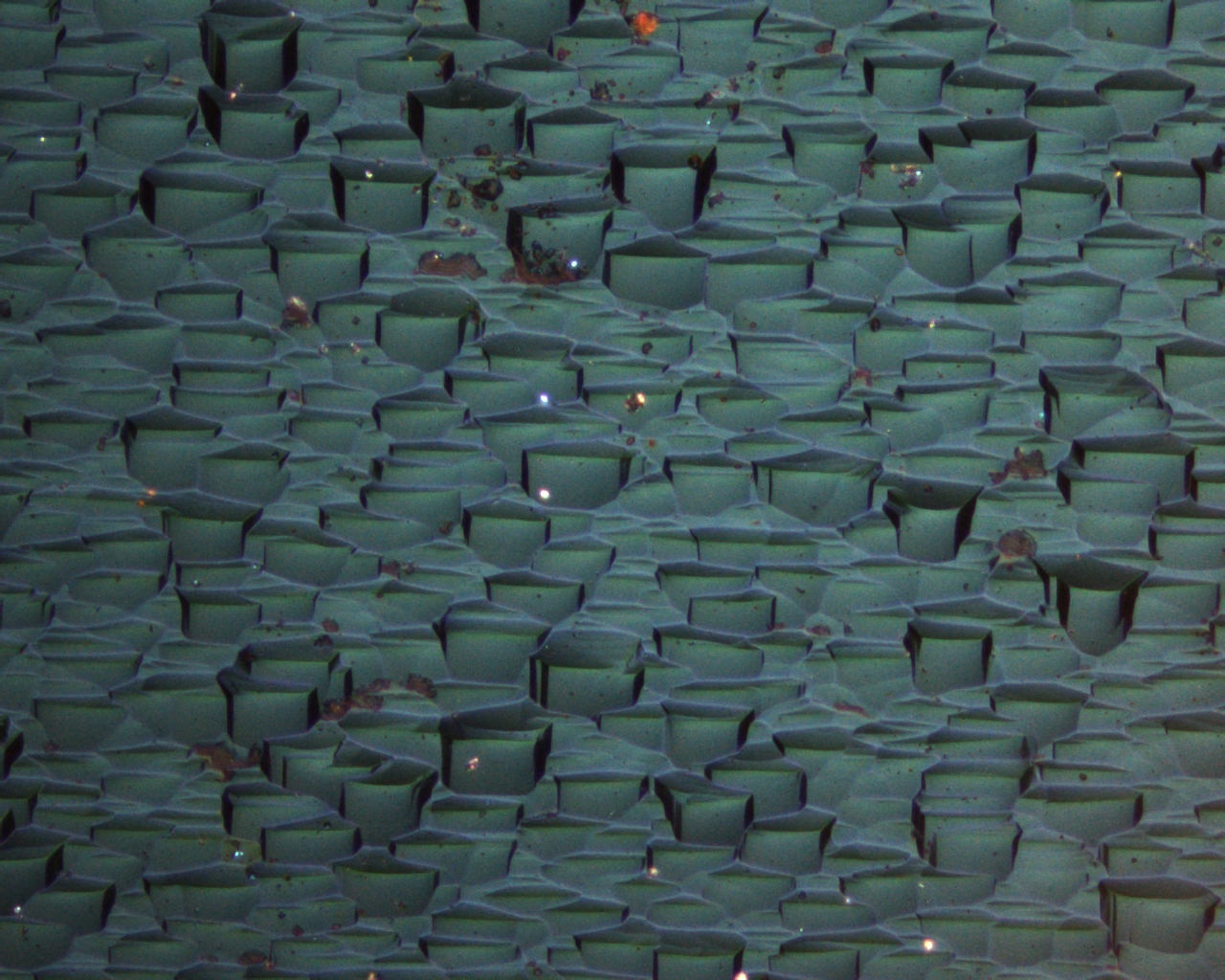
Inverted Microscope : JNO-CKX53M Camera : AcquCAM 3GInverted Microscope : JNO-CKX53M Camera : AcquCAM 3G상기 이미지는 반사 편광이미지 입니다. 검광자(Analrizer)를 회전 시켜서 샘플의 다양한 편광특성의을 확인할 수 있습니다.
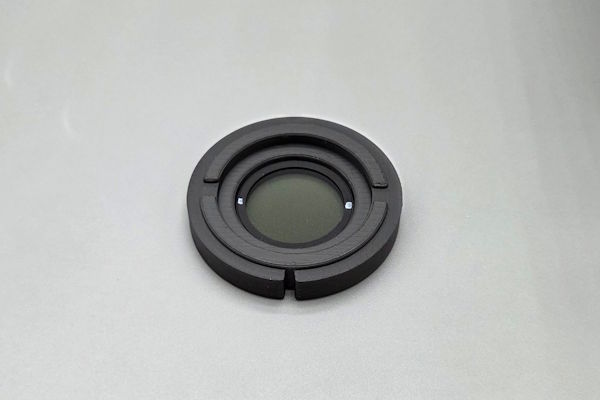
JNO-TPL 투과 현미경용 편광자 Polarizer for Transmitted Microscopy
Bright Field 관찰법은 현미경 관찰의 시작이라고 할 수 있습니다. 샘플을 확대하는 등의 여러 발명은 아주 오랜 전 부터 기록을 볼 수 있었으며, 1590년대의 네덜란드인 얀센 (Zacharias Jansen)이 현재의 현미경과 같은 구조의 현미경을 제작하였고, 그 이후로 현대에 이르기까지 다양한 관찰법의 시작점으로 사용되어 지고 있습니다.
Bright Field 현미경의 개요
가장 기본이 되는 관찰법.
금속 또는 산업현미경
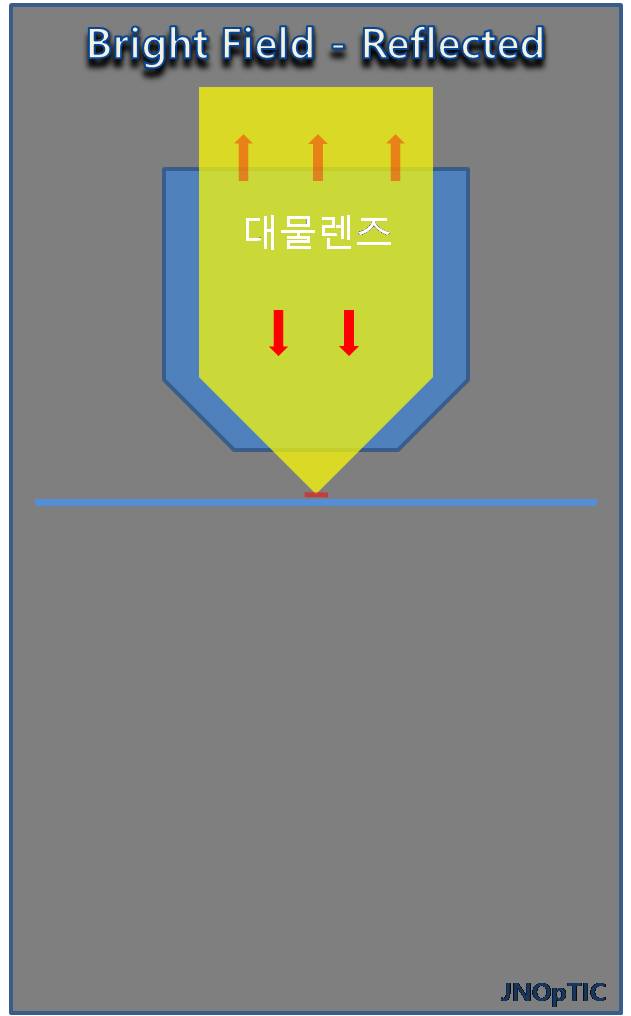
대부분의 샘플이 불투명하여 반사조명을 주로 사용
생물 현미경
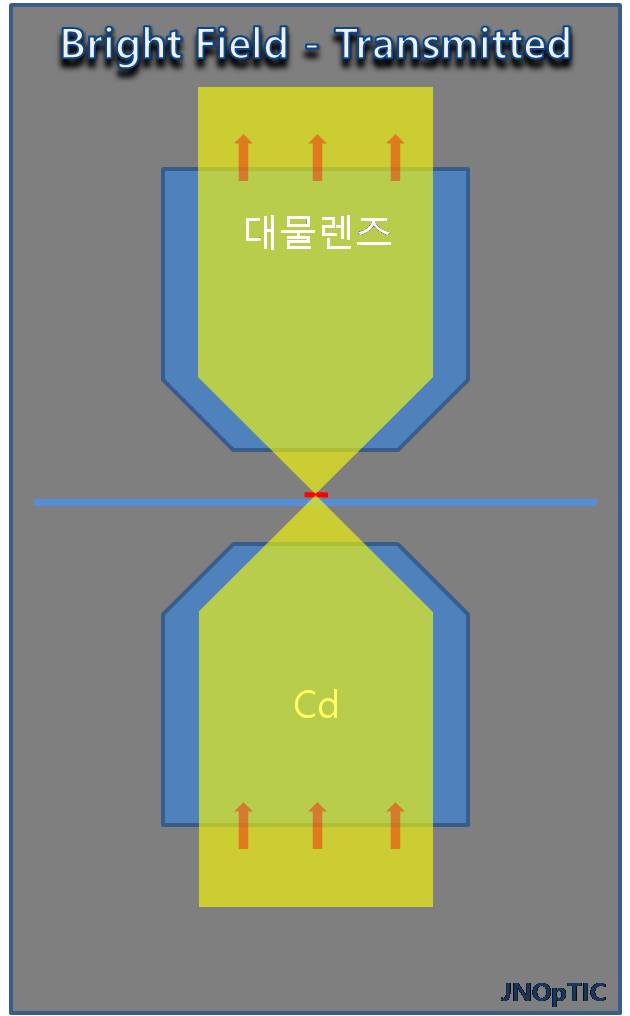
대부분의 샘플이 투명하여 투과조명을 주로 사용
필요에 따라서 반사와 투과 조명을 동시에 사용하는 경우도 있음.
반사 현미경과 투과현미경에서 조명 차이
Reflected Bright fieldTransmitted Bright field
Bright Field 현미경의 설명
샘플을 단순 확대 관찰 용도이며, 특수한 광학유닛을 필요로 하지 않는 기본 관찰 방법입니다. 현미경에서 사용되는 조명계는 과거에는 Critical illumination을 사용하였으나, 현재에 판매되는 대부분의 현미경의 조명계는 쾰러 일루미네이션(Köhler illumination )을 사용하고 있습니다.
조명에 의해 만들어 지는 결상계와 샘플에 의해 만들어지는 결상계가 서로 영향을 미치지 않도록 설계되어 있으며, 조명의 결상에 의해 발생하는 샘플의 이미지 저하를 최소화 한 조명계입니다.
critical illumination : 예전에 사용하였던 조명 방법으로 조명의 결상계과 샘플의 결상계가 서로 중복 결상되도록 되어 있어서, 샘플의 관찰을 할 때 조명의 상과 샘플의 상이 중복되어 관찰되어 이미지의 저하가 발생합니다.
수차(aberration)의 종류
자이델의 5수차 (The Five Seidel Aberrations )
Spherical Aberration ( 구면수차 )
Coma ( 혜성형 수차 )
Astigmatism ( 비점수차 )
Curvature of field ( 상면만곡 ) _ 대물렌즈의 보정 표시 ( PLAN )
Distortion ( 왜곡 )
색수차 ( Chromatic aberration )
가시광선 대역에 있어서 파장이 짧은 보라색의 빛과 파장이 긴 붉은색의 빛의 굴절율을 보면 파장이 짧을 수록 렌즈를 통과한 후의 굴절율이 크고, 파장이 길수록 굴절율이 작아지기 때문에 하나의 렌즈로 빛을 결상하고자 할때 파장에 따라 결상 위치에 차이를 발생하게 됩니다. 일반적으로 현미경에서 사용되는 대물렌즈는 이러한 색수차에 의한 문제점을 보정 하는 정도로 다음과 같이 대물렌즈의 등급을 분류하고 있습니다.